Coolmymind
OverthinkingCBT

How to Stop Ruminating at Night: A CBT and ACT-Based Approach

By Coolmymind Team10 July 20265 min read

It is exhausting to feel like your brain won’t turn off. You lie in bed, physically tired, but your mind replays a highlight reel of everything you said wrong today, or previews everything that might go wrong tomorrow. This pattern — going over the same thoughts again and again without reaching a resolution — is called rumination, and it is one of the most common reasons people struggle to fall asleep.

The good news is that rumination is not a personality flaw or a sign that something is broken in you. It is a well-studied cognitive habit, and it responds well to specific, practical techniques drawn from cognitive behavioral therapy (CBT) and acceptance and commitment therapy (ACT).

Why Your Brain Chooses Bedtime to Worry

During the day, your attention is occupied by tasks, conversations, and sensory input. At night, with the lights off and the to-do list finally quiet, your brain shifts into what neuroscientists call the Default Mode Network (DMN) — a set of brain regions that becomes active when you are not focused on the outside world.

The DMN is deeply involved in self-referential thinking: reviewing memories, imagining the future, and evaluating how we’re doing socially. This is useful for planning and reflection, but it comes with a catch. Human brains carry a well-documented negativity bias — an evolutionary tendency to weigh threats and mistakes more heavily than neutral or positive events, because historically, missing a threat was more costly than missing a reward. So when your mind wanders unstructured at night, it doesn’t wander evenly. It tends to snag on worry, conflict, and perceived failure.

Understanding this mechanism matters because it reframes the problem. You are not failing to relax through some personal weakness; you are dealing with a predictable feature of how unstructured attention works after dark. That shift alone tends to reduce the secondary frustration (“why can’t I just stop thinking about this?”) that often makes rumination worse.

Technique 1: Schedule “Worry Time”

One of the most reliable CBT tools for rumination is deliberately scheduling time to worry earlier in the day — typically 10 to 15 minutes, at the same time each day, well before bed.

During this window, write down whatever is on your mind: unresolved conversations, looming deadlines, “what if” scenarios. You are not trying to solve everything; you are giving your brain permission to externalize the thoughts onto paper instead of carrying them internally.

When a worry resurfaces at night, you can use a simple, practiced response: “I already gave this time today. I’ll look at it again tomorrow during worry time.” This isn’t suppression — you’re not telling yourself to stop thinking about it forever. You’re renegotiating when, which is a much easier ask for an anxious brain than never.

Technique 2: Cognitive Defusion (from ACT)

Traditional CBT often works by examining a thought and testing whether it’s accurate — a process called cognitive restructuring. ACT adds a complementary tool called cognitive defusion, which changes your relationship to a thought rather than arguing with its content.

Instead of thinking, “I’m going to fail tomorrow,” try reframing it as: “I’m having the thought that I’m going to fail tomorrow.”

This small linguistic shift creates psychological distance. A thought is no longer a fact you’re inside of — it becomes an event you’re observing. Some people find it helpful to go a step further: “I notice I’m having the thought that I’m going to fail tomorrow.” Each added layer of observation loosens the thought’s grip a little more.

This technique is particularly useful for worries that don’t have a clean resolution — the ones that aren’t really about solving a problem, but about tolerating uncertainty.

Technique 3: The 4-7-8 Breathing Technique

Rumination isn’t purely cognitive — it also has a physiological component. Anxious thinking tends to activate the sympathetic nervous system (the body’s alert system), which makes it harder to feel sleepy even once the thoughts slow down.

The 4-7-8 technique is a simple way to signal safety to your nervous system:

  1. Exhale completely through your mouth.
  2. Inhale quietly through your nose for a count of 4.
  3. Hold your breath for a count of 7.
  4. Exhale completely through your mouth for a count of 8.
  5. Repeat for four full cycles.

The extended exhale is the key mechanism — longer exhales relative to inhales help activate the parasympathetic nervous system, the body’s “rest and digest” state. You may not feel dramatically different after one round, but with consistent practice most people find it noticeably easier to downshift at night.

Technique 4: Mental Compression (“Name It, Don’t Narrate It”)

When a rumination loop starts, it often unfolds as a long, detailed internal narrative. One practical CBT-style tool is to interrupt the narrative by compressing it into a short label: “worry about the meeting,” “replay of the argument,” “money stress.”

Naming the pattern — rather than narrating it in full — engages a different mode of processing. Research on affect labeling suggests that briefly naming an emotional experience can reduce its intensity, likely by engaging prefrontal regions involved in regulation. You’re not analyzing the thought further; you’re simply tagging it and letting it pass, the way you might note a car passing outside without following it down the street.

Putting It Together

None of these techniques require you to “just stop thinking” — which rarely works and often backfires. Instead, each one changes your relationship to nighttime thoughts in a specific way:

  • Worry time gives anxious thoughts a scheduled outlet earlier in the day.
  • Cognitive defusion creates distance between you and the content of a thought.
  • 4-7-8 breathing calms the physiological arousal that keeps rumination going.
  • Naming, not narrating interrupts the loop before it gathers momentum.

Try one technique consistently for a week before adding another — this makes it much easier to notice what’s actually helping. If rumination is severe, persistent, or connected to a broader pattern of anxiety or depression that isn’t improving with self-help strategies, a licensed therapist trained in CBT or ACT can help you build a more personalized plan.

This article is educational and does not replace personalized care from a licensed mental health professional. If you’re in crisis, please contact a local emergency service or crisis helpline.
Related Articles

Books You May Find Useful

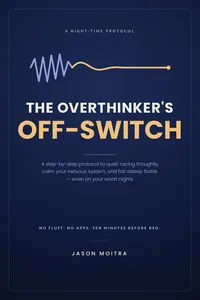
The Overthinker's Off-Switch: A Night-Time Protocol, by Jason Moitra
OverthinkingAnxietyCoolmymind Original

The Overthinker's Off-Switch

Jason Moitra

A step-by-step, no-fluff protocol for quieting a racing mind at night — built around the idea that there are only three kinds of 2am thoughts, and each one needs a different response. Includes a 10-minute wind-down routine, a plan for the moment you wake up already spiraling, and a 30-day path to a calmer nightly routine.

Who it's for

Anyone who regularly lies awake overthinking — replaying conversations, worrying about tomorrow, or unable to switch their brain off at night. It's a practical tool, not a replacement for therapy — and it says so honestly if what you're dealing with needs more support than a book can offer.

OverthinkingMindfulnessPersonal Growth

Get Out of Your Mind and Into Your Life

Steven C. Hayes, PhD

Written by the founder of Acceptance and Commitment Therapy (ACT), this book offers a genuinely different approach to overthinking: instead of trying to argue with or eliminate unwanted thoughts, it teaches you to change your relationship to them entirely, so they lose their grip regardless of whether they go away.

Who it's for

Readers who've tried to logically argue their way out of overthinking without success, and want to try the ACT approach of changing their relationship to thoughts instead.

OverthinkingAnxiety

Overcoming Unwanted Intrusive Thoughts

Sally M. Winston, PsyD & Martin N. Seif, PhD

For the specific, often distressing experience of intrusive, unwanted thoughts that loop uninvited, this book by two anxiety specialists offers real clarity and relief — explaining why everyone has strange intrusive thoughts, and why trying to push them away is exactly what keeps them coming back.

Who it's for

Readers dealing specifically with distressing, unwanted intrusive thoughts (not just general worry), who want to understand why the harder they try to stop them, the more they persist.

OverthinkingAnxiety

The Worry Trick

David Carbonell, PhD

Written by a psychologist who specializes in anxiety, this book explains worry as a trick your brain plays on itself — convincing you that more worrying equals more safety, when it actually just prolongs distress. It's especially good at explaining why trying to reason your way out of worry often backfires, and what to do instead.

Who it's for

Readers who intellectually know their worry is excessive but can't seem to reason their way out of it, and want to understand why logic alone doesn't work.

OverthinkingCBTMindfulnessHabits

Declutter Your Mind

S.J. Scott & Barrie Davenport

This book treats mental clutter the same way productivity books treat physical clutter — as something you can systematically identify and clear out. It combines CBT-style techniques with mindfulness and habit-building, giving readers a genuinely varied toolkit rather than a single-technique approach to quieting a busy mind.

Who it's for

Readers who like the idea of "decluttering" as a framework, and want a varied toolkit spanning CBT, mindfulness, and habit change rather than one single method.

OverthinkingAnxiety

Stop Overthinking

Nick Trenton

A short, focused, no-filler book that goes straight at the mechanics of chronic overthinking — why your brain loops, and specific techniques to interrupt it. If you want something you can read in a weekend and start applying immediately, this is one of the more approachable, action-oriented options in this category.

Who it's for

Readers who want a short, practical, jargon-light introduction to overthinking specifically, without a long theoretical build-up.

Self-EsteemCBT

Self-Esteem: A Proven Program of Cognitive Techniques

Matthew McKay & Patrick Fanning

This workbook applies CBT specifically to the inner critic and harsh self-judgment, giving you the same structured, exercise-driven approach used for anxiety and depression but aimed squarely at how you talk to yourself. It's a practical complement to more theory-driven self-esteem books, focused on actually changing the pattern rather than just understanding it.

Who it's for

Readers whose low self-esteem shows up mainly as harsh self-criticism and negative self-talk, who want a structured, CBT-based way to work on it directly.

CBTAnxietyOverthinking

The Anxiety and Worry Workbook

David A. Clark & Aaron T. Beck

Co-written by the founder of cognitive therapy himself, this workbook applies the core CBT model specifically to anxiety and chronic worry, with the exercises and rigor of a clinical program. If Feeling Great or Mind Over Mood felt broad, this is the more anxiety-specific companion, built on the same foundational research.

Who it's for

Readers whose primary struggle is anxiety and worry specifically (rather than depression), who want a CBT workbook built specifically around that presentation.

CBTDepression

Cognitive Therapy of Depression

Aaron T. Beck, A. John Rush, Brian F. Shaw & Gary Emery

Written by the psychiatrist who founded cognitive therapy itself, this is the original clinical text that everything else in the CBT space ultimately builds on. It's more academic than the average self-help book, but for readers who want to go straight to the source and understand CBT's actual theoretical foundations, there's no more authoritative option.

Who it's for

Readers who want to understand CBT at its clinical, foundational level — including students, clinicians-in-training, or self-help readers who've outgrown pop-psychology explanations and want the real depth.

CBTAnxietyDepression

Retrain Your Brain: Cognitive Behavioral Therapy in 7 Weeks

Seth J. Gillihan, PhD

For readers who want structure and a defined finish line, this book compresses core CBT skills into a specific seven-week program with a clear weekly focus. It's less overwhelming than a comprehensive workbook and more like a guided course you can actually complete, making it a great entry point if the idea of an open-ended self-help book feels daunting.

Who it's for

Readers who do best with a structured, time-bound program rather than an open-ended workbook, and want to feel a sense of completion.

CBTDepressionAnxiety

Mind Over Mood

Dennis Greenberger & Christine A. Padesky

Used by therapists as an actual course of treatment, not just recommended reading, Mind Over Mood is one of the most clinically respected CBT workbooks in print. Its structured, worksheet-driven approach means you're not just reading about cognitive therapy — you're actually doing it, step by step, the same way a therapist would guide you through it in session.

Who it's for

Readers who want a genuinely clinical-grade CBT workbook — the kind therapists assign as homework — for depression, anxiety, or a mix of both.

AnxietyCBT

The Anxiety and Phobia Workbook

Edmund J. Bourne

This is the book therapists themselves recommend most often for anxiety — a comprehensive, practical workbook rather than a memoir or theory-heavy read. If you want one thorough resource that covers relaxation techniques, cognitive restructuring, exposure therapy, and lifestyle factors all in one place, this is the closest thing to a complete anxiety toolkit in a single volume.

Who it's for

Readers who want a structured, workbook-style resource covering the full range of anxiety — generalized anxiety, panic, phobias, and social anxiety — rather than a book focused on just one presentation.

DepressionCBT

Feeling Good: The New Mood Therapy

Dr. David D. Burns

Millions of copies sold and still recommended by therapists today, Feeling Good is the original, foundational book that brought cognitive therapy for depression to a general audience. If you want to understand exactly how your thoughts generate your mood — and get a genuinely practical toolkit for changing that — this is the classic starting point.

Who it's for

Anyone experiencing depression or persistent low mood who wants a clear, structured, and thoroughly evidence-based introduction to cognitive therapy.

CBTDepressionAnxiety

Feeling Great

Dr. David D. Burns

A modern follow-up to the classic 'Feeling Good', presenting Dr. Burns's TEAM-CBT method for rapidly identifying and reframing the cognitive distortions that drive depression and anxiety.

Who it's for

Anyone experiencing persistent low mood, self-criticism, or anxiety who wants a structured, workbook-style approach grounded in cognitive behavioral therapy.

Comments (5)

Ananya Iyer

11 July 2026

The 4-7-8 breathing genuinely helped me fall back asleep last night after a 2am spiral. Wasn't expecting it to work that fast.

Coolmymind TeamAdmin

12 July 2026

So glad to hear that, Ananya — the extended exhale really does have a fairly quick calming effect for a lot of people.

Rohan Mehta

13 July 2026

Does 'worry time' actually work if my brain doesn't believe the worry will really wait until tomorrow?

Coolmymind TeamAdmin

14 July 2026

That skepticism is really common at first, Rohan — it usually takes a few consistent days of actually following through (writing it down, then genuinely revisiting it the next day) before your brain starts trusting the deal. Consistency matters more than believing it will work immediately.

Sarah Mitchell

15 July 2026

The Default Mode Network explanation made my 2am spirals feel a lot less like a personal failure and more like biology.

Coolmymind TeamAdmin

16 July 2026

That's exactly the shift we hoped this would create, Sarah — understanding the mechanism tends to remove a lot of the added self-blame.

Nikhil Verma

18 July 2026

Cognitive defusion — 'I'm having the thought that...' — is such a small change but it really does create distance. Using it constantly now.

Coolmymind TeamAdmin

19 July 2026

Great to hear, Nikhil — that small linguistic shift is one of the more surprisingly powerful tools in this list.

Divya Krishnan

20 July 2026

Is there a risk of using these techniques as a way to just suppress bigger issues that actually need therapy?

Coolmymind TeamAdmin

21 July 2026

Important question, Divya. These tools work well for everyday rumination, but if the underlying worry is tied to a persistent anxiety or mood issue that isn't improving, that's a good sign to bring in a therapist rather than relying on self-help tools alone.

Leave a comment

Comments are reviewed before they're published, so yours may not appear immediately.