Coolmymind

Hypervigilance: Why You Always Feel Like Something Bad Is About to Happen

By Coolmymind Team14 July 20265 min read

You walk into a room and, without deciding to, immediately clock the exits, notice who’s standing where, and register any change in tone before anyone’s said a word. You sit facing the door out of habit. A sudden noise makes you jump harder than it probably should. Even in objectively calm, safe moments, some part of you doesn’t quite believe it — there’s a background hum of “something’s about to go wrong” that doesn’t fully switch off, even when you rationally know you’re fine.

This pattern has a name: hypervigilance. It’s exhausting, often misunderstood — even by the person experiencing it — and it’s one of the more common ways that past trauma or prolonged stress shows up in daily life.

What Hypervigilance Actually Is

Hypervigilance is a persistently heightened state of alertness to potential threat, even in situations that are objectively safe. It’s not the same as ordinary carefulness or situational awareness — it’s a chronic, effortful, and often involuntary scanning for danger that doesn’t turn off just because the immediate environment is calm.

Clinically, hypervigilance is a recognized feature of post-traumatic stress and is also common after prolonged periods of unpredictable stress, even without a single identifiable traumatic event — for example, growing up in an unpredictable or unsafe household, or living through an extended period of instability.

Why It Happens

Hypervigilance makes much more sense once you understand what it was built to do. After a genuinely threatening experience, the brain’s threat-detection system — centered on the amygdala — can become more sensitized, essentially lowering the threshold for what counts as a potential danger signal. This isn’t a malfunction; it’s an adaptation. If a certain kind of situation once led to real harm, a nervous system that stays alert to anything resembling that situation again is, in a narrow sense, doing its job of trying to keep you safe.

The problem is that this heightened sensitivity tends to generalize far beyond the original threat, and it doesn’t come with an easy off-switch. A nervous system that’s learned “stay alert, danger can appear without warning” often keeps applying that rule broadly, long after the actual danger has passed, because from a purely protective standpoint, over-detecting a threat feels less costly than missing a real one.

The Hidden Cost of Constant Alertness

Hypervigilance isn’t just an uncomfortable mental habit — it has a real physiological cost, similar to the effects of chronic stress described in our article on burnout. Constantly scanning for threat keeps the sympathetic nervous system engaged for extended periods, which is associated with:

  • Difficulty falling or staying asleep, since true rest requires the nervous system to stand down
  • Chronic muscle tension, headaches, and fatigue
  • Difficulty concentrating, since attention is partly consumed by ongoing threat-scanning
  • Strain on relationships, since it can be hard to fully relax or feel close to people even when you want to

Many people with hypervigilance don’t initially connect these physical and relational effects back to the underlying pattern — they just know they’re tired, tense, and can’t quite explain why relaxing feels so difficult.

Recognizing Hypervigilance in Yourself

A few common signs, on their own or together:

  • Automatically positioning yourself facing exits or with your back to a wall
  • Being startled more intensely than the situation warrants by sudden sounds or movement
  • Difficulty relaxing or “letting your guard down,” even in familiar, safe settings
  • Scanning new environments for potential threats or escape routes without consciously deciding to
  • A persistent sense that something bad is about to happen, without a specific, identifiable reason

If several of these feel familiar, it doesn’t mean something is wrong with you — it means your nervous system adapted to circumstances that, at some point, called for exactly this kind of alertness.

What Helps

1. Name the pattern without judgment

Simply recognizing “this is hypervigilance, a nervous system pattern, not an accurate read of current danger” can create a small but meaningful shift — similar to labeling a trigger, discussed in our companion article on trauma triggers. It doesn’t switch off the alertness immediately, but it stops you from treating the alarm as automatically accurate information about the present.

2. Build deliberate safety cues

Since hypervigilance involves an ongoing, low-grade search for danger, it can help to deliberately build moments and spaces that are strongly associated with safety — a specific room, a particular routine, time with specific trusted people — and notice, on purpose, that you’re safe there. Over time and with repetition, this can help build a wider felt sense of safety, though it’s usually a gradual process rather than a quick fix.

3. Ground yourself in current, sensory reality

The same grounding practice described in our trauma triggers article works here too: naming what you can currently see, hear, and physically feel helps anchor attention in the actual present environment, rather than the generalized, background sense of threat.

4. Support the body’s ability to downshift

Because hypervigilance keeps the sympathetic nervous system engaged, practices that actively support the parasympathetic “rest” state — slow, extended-exhale breathing, gentle movement, adequate sleep hygiene — can help counterbalance some of the physiological cost, even if they don’t resolve the underlying pattern on their own.

5. Be patient with a slow timeline

Hypervigilance developed as a protective adaptation, often over an extended period, and it typically doesn’t resolve quickly. Expecting yourself to simply “relax more” is usually an unrealistic bar; gradual, supported change is a more realistic and kinder expectation to hold.

When to Seek Professional Support

Hypervigilance is one of the more treatable trauma-related patterns, particularly with approaches like trauma-focused CBT, EMDR, and somatic-based therapies, which directly address the nervous system dysregulation underlying it rather than just the surface-level anxiety. If hypervigilance is significantly affecting your sleep, relationships, or ability to feel safe in ordinary daily life, a licensed trauma-informed therapist can help in ways that self-directed strategies alone typically can’t fully replicate.

This article is educational and does not replace personalized care from a licensed mental health professional trained in trauma-informed care. If you’re in crisis, please contact a local emergency service or crisis helpline.
Related Articles

Books You May Find Useful

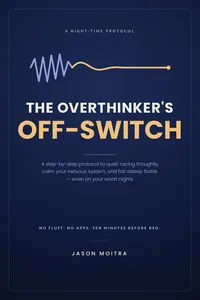
The Overthinker's Off-Switch: A Night-Time Protocol, by Jason Moitra
OverthinkingAnxietyCoolmymind Original

The Overthinker's Off-Switch

Jason Moitra

A step-by-step, no-fluff protocol for quieting a racing mind at night — built around the idea that there are only three kinds of 2am thoughts, and each one needs a different response. Includes a 10-minute wind-down routine, a plan for the moment you wake up already spiraling, and a 30-day path to a calmer nightly routine.

Who it's for

Anyone who regularly lies awake overthinking — replaying conversations, worrying about tomorrow, or unable to switch their brain off at night. It's a practical tool, not a replacement for therapy — and it says so honestly if what you're dealing with needs more support than a book can offer.

Trauma and Recovery

Judith Lewis Herman, MD

First published decades ago and still considered foundational, this is the book that established much of the modern clinical framework for understanding trauma and its treatment, from combat trauma to domestic abuse. It's more academic in tone than newer trauma books, but its influence on the entire field makes it essential context for understanding where current trauma treatment came from.

Who it's for

Readers who want the foundational, clinically authoritative text on trauma and recovery, including its social and political dimensions, not just individual coping strategies.

It Didn't Start With You

Mark Wolynn

This book explores a genuinely fascinating and still-developing area of trauma research: how trauma and its effects can be passed down across generations, shaping anxieties and patterns whose true origin isn't in your own life story at all. For readers who feel like a fear or pattern doesn't quite make sense given their own history, this offers a compelling explanation.

Who it's for

Readers who sense that a persistent fear, anxiety, or pattern doesn't fully make sense given their own life experience, and want to explore possible family or generational roots.

Complex PTSD: From Surviving to Thriving

Pete Walker

Written specifically for the effects of prolonged, repeated trauma (like childhood emotional neglect or abuse) rather than a single traumatic event, this book gives a name and framework to a set of experiences — like the "emotional flashback" — that often go unrecognized and unaddressed by more general trauma resources.

Who it's for

Readers whose trauma stems from prolonged or repeated experiences, particularly childhood emotional neglect or abuse, rather than a single traumatic incident — best read alongside professional support.

Waking the Tiger

Peter A. Levine, PhD

Peter Levine developed Somatic Experiencing, a body-based approach to trauma recovery, after observing that wild animals routinely experience life-threatening events without developing lasting trauma the way humans often do. This book explains that observation and the body-centered healing approach it led to, in accessible, non-clinical language.

Who it's for

Readers interested in a body-based, rather than purely talk-based, understanding of trauma and its resolution — best read alongside professional support.

The Body Keeps the Score

Bessel van der Kolk, MD

One of the most influential books on trauma ever published, this book makes the case — now widely supported by neuroscience — that trauma isn't just a psychological memory, it's stored in the body itself, which is why talk therapy alone sometimes isn't enough. It's essential reading for understanding why trauma affects sleep, relationships, and physical health, not just mood.

Who it's for

Readers who've experienced trauma and want to understand why it affects the body and nervous system so directly, not just thoughts and memories — best read alongside professional support.

The Relaxation and Stress Reduction Workbook

Martha Davis, Elizabeth Robbins Eshelman & Matthew McKay

In print for decades and updated across multiple editions, this is less a book you read once and more a reference toolkit you return to — covering nearly every evidence-based relaxation technique in one place, from progressive muscle relaxation to biofeedback to time management. If you want breadth and a technique for every situation, this covers the most ground.

Who it's for

Readers who want a comprehensive reference of relaxation and stress-management techniques to draw from, rather than committing to just one method.

Overcoming Unwanted Intrusive Thoughts

Sally M. Winston, PsyD & Martin N. Seif, PhD

For the specific, often distressing experience of intrusive, unwanted thoughts that loop uninvited, this book by two anxiety specialists offers real clarity and relief — explaining why everyone has strange intrusive thoughts, and why trying to push them away is exactly what keeps them coming back.

Who it's for

Readers dealing specifically with distressing, unwanted intrusive thoughts (not just general worry), who want to understand why the harder they try to stop them, the more they persist.

The Worry Trick

David Carbonell, PhD

Written by a psychologist who specializes in anxiety, this book explains worry as a trick your brain plays on itself — convincing you that more worrying equals more safety, when it actually just prolongs distress. It's especially good at explaining why trying to reason your way out of worry often backfires, and what to do instead.

Who it's for

Readers who intellectually know their worry is excessive but can't seem to reason their way out of it, and want to understand why logic alone doesn't work.

Stop Overthinking

Nick Trenton

A short, focused, no-filler book that goes straight at the mechanics of chronic overthinking — why your brain loops, and specific techniques to interrupt it. If you want something you can read in a weekend and start applying immediately, this is one of the more approachable, action-oriented options in this category.

Who it's for

Readers who want a short, practical, jargon-light introduction to overthinking specifically, without a long theoretical build-up.

The Anxiety and Worry Workbook

David A. Clark & Aaron T. Beck

Co-written by the founder of cognitive therapy himself, this workbook applies the core CBT model specifically to anxiety and chronic worry, with the exercises and rigor of a clinical program. If Feeling Great or Mind Over Mood felt broad, this is the more anxiety-specific companion, built on the same foundational research.

Who it's for

Readers whose primary struggle is anxiety and worry specifically (rather than depression), who want a CBT workbook built specifically around that presentation.

Retrain Your Brain: Cognitive Behavioral Therapy in 7 Weeks

Seth J. Gillihan, PhD

For readers who want structure and a defined finish line, this book compresses core CBT skills into a specific seven-week program with a clear weekly focus. It's less overwhelming than a comprehensive workbook and more like a guided course you can actually complete, making it a great entry point if the idea of an open-ended self-help book feels daunting.

Who it's for

Readers who do best with a structured, time-bound program rather than an open-ended workbook, and want to feel a sense of completion.

Mind Over Mood

Dennis Greenberger & Christine A. Padesky

Used by therapists as an actual course of treatment, not just recommended reading, Mind Over Mood is one of the most clinically respected CBT workbooks in print. Its structured, worksheet-driven approach means you're not just reading about cognitive therapy — you're actually doing it, step by step, the same way a therapist would guide you through it in session.

Who it's for

Readers who want a genuinely clinical-grade CBT workbook — the kind therapists assign as homework — for depression, anxiety, or a mix of both.

Unwinding Anxiety

Dr. Judson Brewer

Written by a psychiatrist and neuroscientist who studies habit loops, this book treats anxiety as something that can be examined and "unwound" the same way any other unhelpful habit can — through curiosity about the anxious pattern rather than a battle against it. It's a more mindfulness-oriented alternative for readers who've found conventional CBT-only approaches too rigid.

Who it's for

Readers who are drawn to mindfulness-based approaches and want to understand anxiety as a habit loop they can work with, rather than a threat to eliminate.

Rewire Your Anxious Brain

Catherine M. Pittman & Elizabeth M. Karle

If you're the kind of reader who wants to understand the actual neuroscience behind why a technique works before trusting it, this is the anxiety book written for you. It explains the amygdala and cortex pathways involved in anxiety in accessible terms, then matches specific techniques to which brain pathway is driving your particular anxiety.

Who it's for

Readers who want a neuroscience-grounded explanation of anxiety, and who respond better to understanding the "why" behind a technique before trying it.

Hope and Help for Your Nerves

Dr. Claire Weekes

First published decades ago and still recommended today, this book introduced the concept of "floating through" anxiety instead of fighting it — an idea that predates and quietly underlies much of modern anxiety treatment. Its plain, compassionate language has helped generations of readers stop being afraid of their own symptoms.

Who it's for

Readers who want a warm, reassuring explanation of nervous system symptoms — palpitations, trembling, derealization — from a doctor who treated anxiety long before it was widely understood.

The Anxiety and Phobia Workbook

Edmund J. Bourne

This is the book therapists themselves recommend most often for anxiety — a comprehensive, practical workbook rather than a memoir or theory-heavy read. If you want one thorough resource that covers relaxation techniques, cognitive restructuring, exposure therapy, and lifestyle factors all in one place, this is the closest thing to a complete anxiety toolkit in a single volume.

Who it's for

Readers who want a structured, workbook-style resource covering the full range of anxiety — generalized anxiety, panic, phobias, and social anxiety — rather than a book focused on just one presentation.

DARE: The New Way to End Anxiety and Stop Panic Attacks

Barry McDonagh

Most anxiety advice tells you to calm down, which rarely works in the middle of a panic spike. DARE takes the opposite approach — leaning into the sensations instead of fighting them — and it's become one of the most talked-about anxiety books precisely because it addresses the moment of panic itself, not just the calm periods in between.

Who it's for

Anyone who experiences panic attacks or acute anxiety spikes and has already tried "just relax" advice that didn't hold up in the moment it actually mattered.

Feeling Great

Dr. David D. Burns

A modern follow-up to the classic 'Feeling Good', presenting Dr. Burns's TEAM-CBT method for rapidly identifying and reframing the cognitive distortions that drive depression and anxiety.

Who it's for

Anyone experiencing persistent low mood, self-criticism, or anxiety who wants a structured, workbook-style approach grounded in cognitive behavioral therapy.

Comments

Leave a comment

Comments are reviewed before they're published, so yours may not appear immediately.